Mediation Pan African: Equipping the mediation industry for tomorrow
Mediation Pan African (Pty) Ltd is a professional mediation and dispute resolution training and services organisation dedicated to developing high-quality mediators, strengthening ethical practice, and expanding access to affordable, effective dispute resolution throughout South Africa.
By Charlene Labuschagne
In a continent as diverse, dynamic, and fast-growing as Africa, conflict is inevitable, but prolonged disputes, broken relationships, and costly litigation do not have to be. Mediation Pan African was established to help transform how conflict is managed across South Africa: from confrontation to conversation, from division to resolution, and from courts to constructive dialogue.
Mediation Pan African (Pty) Ltd is a professional mediation and dispute resolution training and services organisation dedicated to developing high-quality mediators, strengthening ethical practice, and expanding access to affordable, effective dispute resolution throughout South Africa.
A Vision Rooted in African Realities
Africa’s social, commercial, community, family, and workplace disputes require solutions that are practical, culturally sensitive, and accessible. Mediation Pan African recognises that while global best practices are important, dispute resolution in South Africa must also respect:
- community structures and customary norms,
- multilingual and multicultural environments,
- economic realities, and
- the need for restorative rather than purely adversarial outcomes.
Our vision is to cultivate a culture where mediation becomes the first choice, not the last resort.
Professional Training with International Standards
A cornerstone of Mediation Pan African’s work is its comprehensive mediation training programme aligned with recognised professional and regulatory standards, including South African and international mediation frameworks.
Our training programmes include:
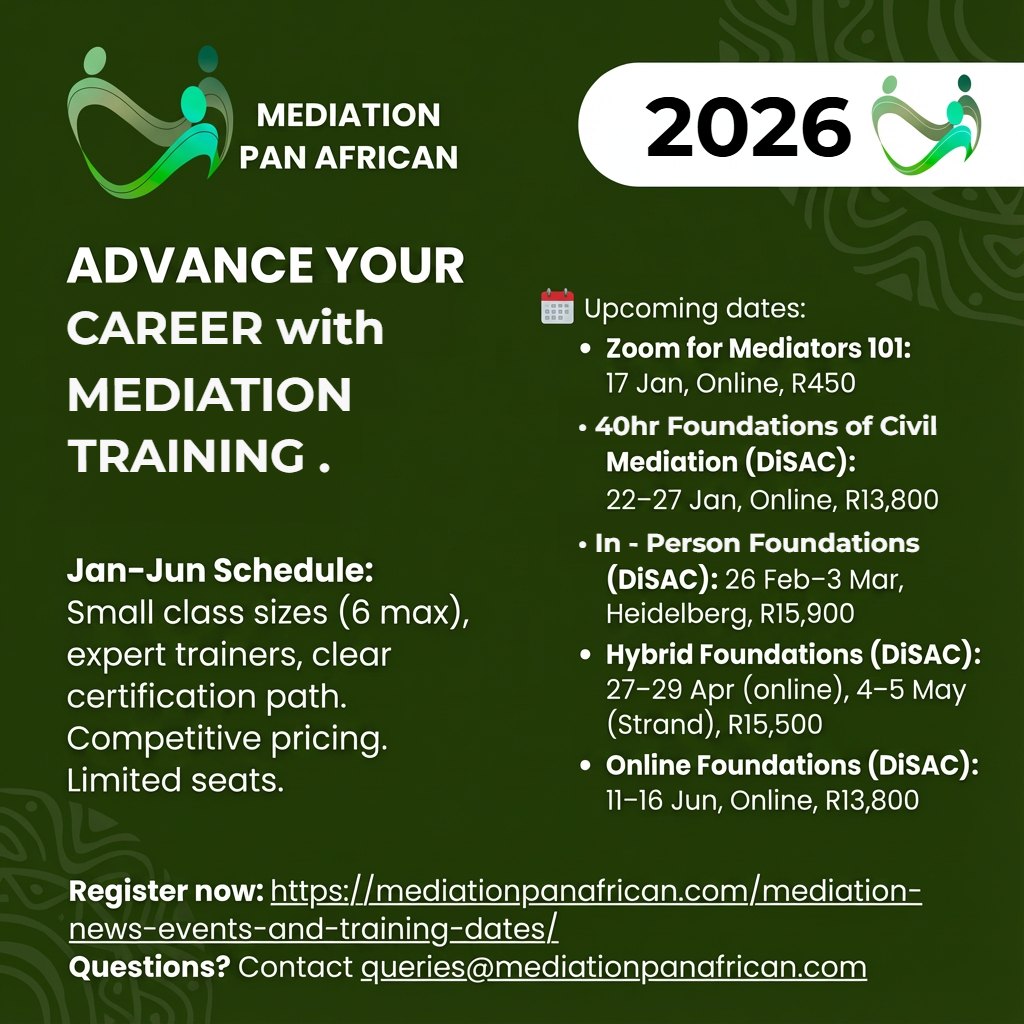
- a 40-hour foundational mediation course,
- specialised modules (commercial, family, workplace, community and clinical disputes),
- ethics and professional conduct training,
- practical role-plays and case simulations, and
- formal assessment and certification.
Expanding Access to Justice
Traditional litigation is expensive, slow, and often destructive to relationships. Mediation Pan African actively promotes mediation as:
- cost-effective,
- confidential,
- faster than court processes,
- relationship-preserving, and
- legally sound.
By training mediators and working with legal practitioners, businesses, NGOs, schools, community organisations, and government institutions, Mediation Pan African helps widen access to justice — particularly for individuals and communities who may otherwise be excluded from formal legal systems.
Ethical Practice and Professional Integrity
Mediation Pan African places strong emphasis on:
- independence and neutrality,
- confidentiality,
- voluntary participation,
- informed consent, and
- professional accountability.
These principles ensure that mediation remains credible, trusted, and legally defensible, while protecting both mediators and participants.
Building South Africa’s Mediation Industry
Beyond individual training, Mediation Pan African is committed to developing mediation as a recognised profession across the continent. This includes:
- supporting accreditation pathways,
- developing standardised training materials,
- promoting mediation panels and practitioner networks,
- contributing to policy discussions on alternative dispute resolution (ADR), and
- advocating for mediation clauses in contracts and institutional frameworks.
Looking Forward
As South Africa continues to grow economically and socially, the demand for effective conflict management will only increase. Mediation Pan African aims to be at the forefront of this transformation by equipping professionals, empowering communities, and helping build systems that favour dialogue over dispute.
In doing so, the organisation contributes not only to resolving conflicts, but to strengthening trust, stability, and sustainable development across the continent.